Build a Reusable Everyday Kit That Fits Your Routine
A reusable kit is less about packing more and more about making one practical swap easy to reach, clean and ready when the right moment comes.
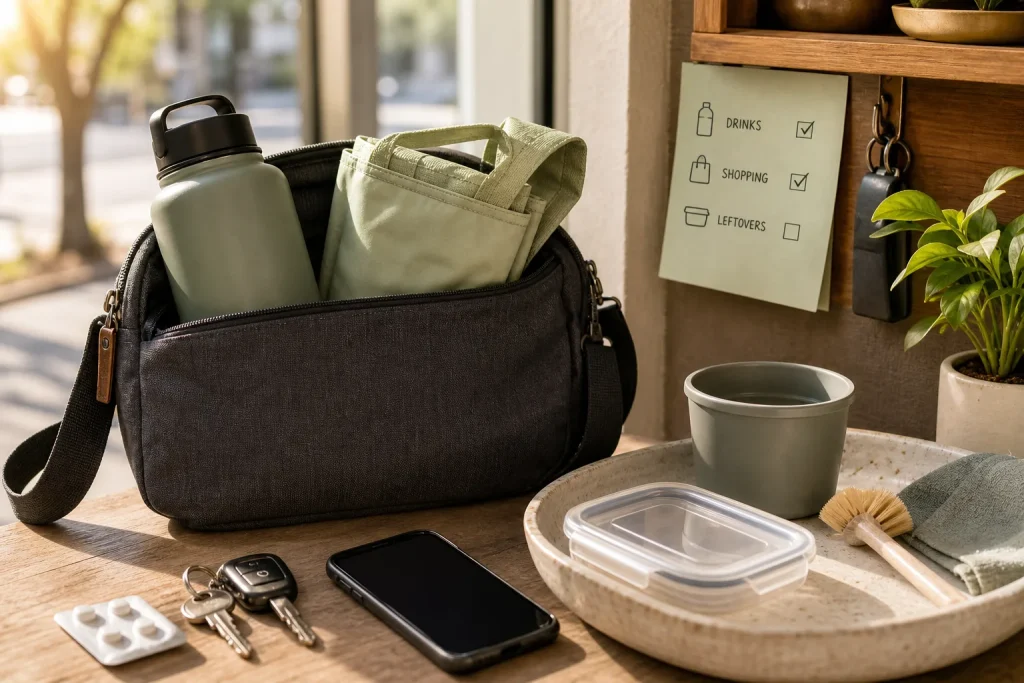
A reusable kit can become a tiny mobile cupboard: a cup, a container, cutlery, bags and a bottle carried just in case. That is often more burden than benefit. A better approach is to treat the kit as a response to a few recurring moments, not as a portable version of every household drawer. Its contents should earn their place through clear, ordinary uses.
Think of the kit as a small piece of infrastructure. It has a home, a way to return there, and a job to do when plans unfold. This perspective changes the design question from “What might I need?” to “What breaks down when I lack a particular item?” The answer can be surprisingly narrow, and it can change with a workday, an errand or a planned outing.
Map the points where disposables enter
Instead of beginning with products, follow one familiar route through the day. Notice the point at which a disposable cup, bag, wrapper or utensil appears, and ask what led to it: a purchase made on impulse, a meal brought from home, or a stop added to the trip. The cause matters. A tote addresses an unplanned purchase; it does not solve a drink purchase, and a container will not help if food is bought only when carrying it is inconvenient.
Choose one recurring point and trace its details: where you are, what you are carrying, whether the business accepts a personal item, and what happens to it afterward. This is a small systems map rather than a tally of good intentions. If the obstacle is that the item is inaccessible, placement may be the answer. If the obstacle is a policy or hygiene concern, a different reusable option—or no swap for that occasion—may make more sense.
Design for one clear job
Give each object a defined assignment. A bottle might be for water on a commute; a lidded container might be for leftovers from a particular lunch stop. A bag could be reserved for groceries rather than asked to carry everything. Clear roles make it easier to judge whether an object belongs and prevent a crowded kit from becoming a collection of overlapping possibilities.
Before choosing an item, picture the task from beginning to end. Can it do the job, travel without causing a mess, and be cleaned with the space and supplies available? Consider closures, materials and care instructions, especially for food or drink. If an object is awkward to wash or store, the inconvenience is part of its design, not a personal failure. Choose another format, or leave that task out of the kit.
Build a return route for every item
Reusable objects need a path back into circulation. Decide where a used cup or container goes when you arrive home, where it dries, and where it waits once clean. A dirty item dropped among clean ones can make the whole kit less inviting. A designated landing place—a tray, shelf or section of a bag—can separate “needs care” from “ready to go” without adding a complicated household system.
Make the return route visible at the moment it matters. For example, if a bottle is often left in a work bag, its next stop might be beside the sink when the bag is unpacked. If a grocery tote disappears into a cupboard, it might instead live by the place where shopping lists and keys are kept. The aim is not to remember harder; it is to make the next useful action obvious and easy to complete.
Keep the kit modular, not universal
A single fixed kit assumes that every outing has the same demands. A modular approach separates a small everyday base from items used for particular plans. The base might be one bottle or bag; a container can join it when bringing home food is likely. This avoids carrying a heavy or bulky object on days when it has no role, while still leaving room to prepare for a known need.
Think in terms of attachment points rather than a perfect all-purpose bag. A pouch can move between bags, or one item can live near a work badge, lunch bag or bicycle helmet. Keep essential belongings—such as medication, keys or a device—clear of food-soiled gear. If switching between bags creates forgotten items, a permanent home for the reusable object may be more dependable than transferring it each time.
Use a decision check before adding items
When considering a new object, ask what specific disposable it would replace, when that situation occurs, and what obstacle currently prevents a reusable choice. Then consider its care and carrying demands. These questions are not a scorecard; they are a way to distinguish a concrete need from the vague comfort of being prepared. If the task is rare, storing the item at home may be more sensible than carrying it daily.
Use the answers to make an actual decision. If the item has a recurring job, fits the available space and can be cleaned, add it. If it solves a real need but is bulky, keep it near the place where that outing begins. If its purpose is uncertain or its care requirements are unrealistic, wait rather than buying it. A deliberate “not now” can keep a useful kit small and prevent duplicate objects from accumulating.
Work through a hypothetical kit redesign
Consider an invented scenario: a commuter’s small shoulder bag contains keys, a phone and medication. The commuter buys a takeaway drink on the walk home on most workdays, sometimes makes an unplanned grocery stop, and does not bring lunch from home. The starting constraints are limited bag space, no convenient washing place during the day and a preference for a light carry. The decision is not to assemble a general-purpose kit, but to address the two situations that actually recur.
First, the commuter checks whether a bottle can fit beside the essentials without pressing against them; it does, so a refillable bottle is assigned to the drink routine and placed beside the keys at home. Next, a foldable shopping bag is tested in the shoulder bag; it fits, so it stays there for the occasional grocery stop. A food container is excluded because there is no lunch to pack and no suitable daytime cleaning place. The resulting tradeoff is explicit: the kit handles drinks and surprise shopping, but not takeaway leftovers. If the bottle crowds the essentials on a short outing, the commuter leaves it at home and keeps the grocery bag as the only everyday item.
A practical reusable kit is not defined by how many alternatives it contains. It is a small arrangement that connects an identifiable need to an object, then gives that object a reliable route back to use. Start with one point where a disposable item appears, design around the real obstacle, and make storage and care part of the plan. When a new object cannot be assigned a clear job, the best edit may be to leave it out.